Styles and Forms
The Venetian Mirror
Why the Venetian mirror is built as a frame of glass rather than wood, how the bevelled border throws light, and what to look at first.
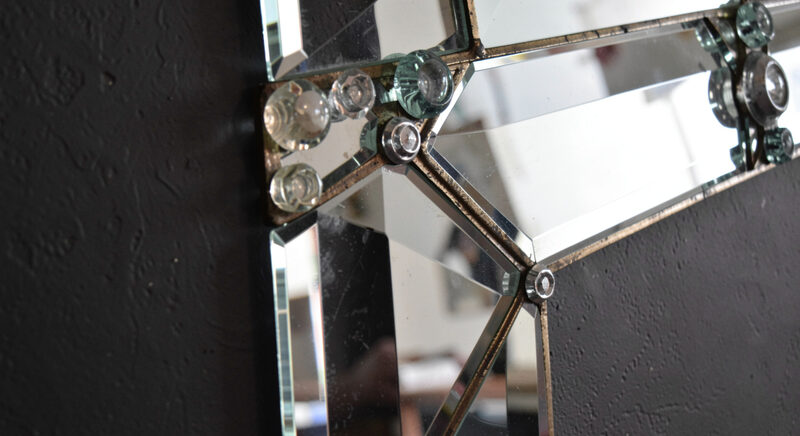
A Venetian mirror is recognised at a glance, and the reason is structural rather than decorative. Almost every other mirror in a house is a sheet of glass held in a frame of wood, metal or plaster. A Venetian mirror reverses that arrangement: the frame itself is made of glass. Once you see the frame as a construction rather than a border, the rest of the object, its weight, its cost, the way it behaves in light and the way it must be handled, follows naturally.
The frame is the mirror
Look closely at the edge of a Venetian mirror and you will see joins. The border is not one piece but many: long straight strips along the sides, shaped pieces at the corners, and decorative elements that project beyond the outline. Each of these is cut, bevelled and polished separately, then fixed to a hidden backing structure. The central pane, the part that actually shows your reflection, is often the least interesting component, because the character of the piece lives in the glass that surrounds it.
What the bevel does
Most pieces in a Venetian frame carry a bevel, a sloping facet ground along their border. A bevel works like a prism. Light arriving from the room is bent and thrown back out at a different angle, so the edge of each piece becomes a bright line rather than a dark seam. The effect is strongest when the mirror is lit from the side, which is why a Venetian mirror seems to come alive when it hangs near a window or opposite a lamp. A frame with no bevel, or with a shallow and uneven one, stays flat no matter how the light changes.
The rosettes
Where the pieces of a Venetian frame meet, you will often find a small glass disc or a shaped ornament, called a rosette. It has a practical job, covering the point where two pieces are fixed together, and an ornamental one, adding another point of reflected light at exactly the place the eye is already drawn. Rosettes vary from plain discs to flower shapes with engraved petals. Their presence, and the way they are set, is one of the quickest ways to tell a hand assembled frame from a moulded imitation, in which the ornament is usually a single cast piece.
What to look at first
When you first examine a Venetian mirror, work in this order. Look at the outline: are the shapes crisp, or are the edges chipped and uneven? Look at the joins: do the pieces sit flush, with rosettes neatly centred, or are there gaps and mismatched heights? Look at the surface: tilt the mirror to the light and check for clouds, spots and uneven patches in the reflective backing. Look at the engraving: is the floral work deep and bright, or shallow and milky? Only then consider the size and the setting, because condition matters more than scale.
Why the construction affects weight
Glass is heavy, and a Venetian mirror is mostly glass. A large crowned mirror can weigh as much as a small piece of furniture, and the weight is not evenly distributed, since the crown concentrates mass at the top. This is why the hidden backing structure matters: it must carry the load without flexing, because glass that flexes under its own weight will eventually crack. It is also why the wall matters. A Venetian mirror of any size needs a fixing that goes into the structure of the wall, not just the plaster, and a large one is often better hung from a batten fixed across two studs. The practical side of hanging is covered in the article on sizes and placement.
Venetian, Murano style and the copies
Not every mirror sold as Venetian is built the same way. The classic type uses clear crystal glass in a glass frame. Murano style mirrors use coloured and gold glass, often with applied flowers, and are described in a separate article. Bubble frames replace the flat border with rows of blown domes, as explained in the page on bubble mirrors. Then there are mirrors that imitate the look with a wooden or resin frame and a printed or applied pattern. These can be perfectly good objects, but they are not the same construction, and they should not be priced as if they were.
How the object is made
The reason a Venetian mirror looks the way it does is the order of work in the workshop: shape first, then bevels and facets, then engraving, then the reflective backing, then assembly. Each stage leaves a visible trace, which is what makes a hand made frame legible to anyone who knows where to look. The full sequence is set out in how a Venetian mirror is made, and the tools and skills behind it are introduced in the craft section.
Where the type came from
The glass frame grew out of a technical problem. When a single large pane was impossible to make, a mirror had to be assembled from several smaller sheets, and the joins had to be hidden. Decorating the joins, and then the whole border, turned a necessity into a style, and the style outlived the necessity. That history is traced in the history section. A concise account of Venetian glass, its techniques and its vocabulary is available in the encyclopaedia entry on Venetian glass, which is a useful companion to the objects themselves.