History and Origins
A History of the Venetian Mirror
How Venetian glassmakers made the first clear mirror in the sixteenth century, why Murano kept the secret and how the craft travelled beyond the lagoon.
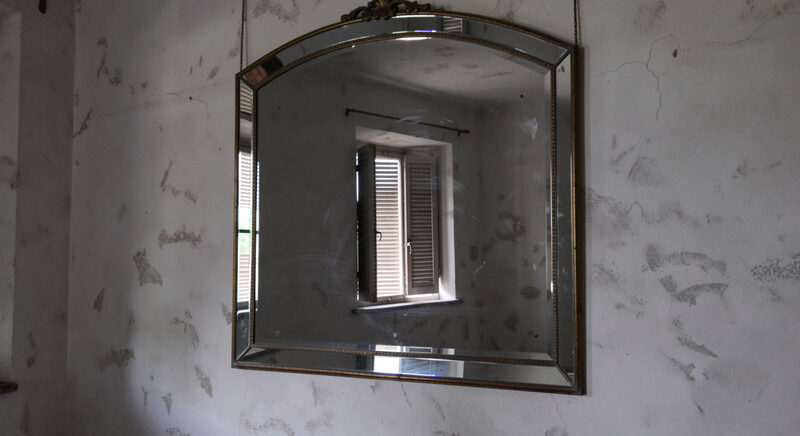
A Venetian mirror is not simply a sheet of glass in a carved frame. It is a structure of glass, built up from small bevelled pieces, joined with tiny rosettes, and decorated with engraving that catches the light from several directions at once. To understand how that object came to exist, it helps to follow the mirror itself, from a dark disc of polished stone to the clear silvered pane that Venetian workshops were the first in Europe to make well.
Before glass: obsidian and metal
The oldest mirrors were not glass at all. Polished obsidian, a natural volcanic glass, was worked into flat reflective surfaces in Anatolia and Central America from around 6000 BCE. The Romans later produced man made glass in enormous quantities and experimented with glass and lead, yet the mirrors they left behind are small and crude. The ability to make clear glass of any size was lost with the western empire, and for centuries a mirror meant a disc of polished metal, usually bronze or silver, held in the hand or set into a small case.
Clear glass returns to Europe
Clear glass making survived in the eastern Mediterranean, and it was through trade with Syria and the wider Levant that Venetian glassmakers recovered the skill. By the fourteenth century, convex mirrors of relatively clear glass and real size were being made in several European cities. The small round mirror at the centre of Jan van Eyck's Arnolfini portrait of 1434 shows what such a mirror could do: it gathers the whole room into a distorted bubble, a picture of everything behind the sitter, and it was painted as a mark of wealth and taste.
Cristallo and the birth of the Venetian mirror
The decisive step came in sixteenth century Murano, the island in the Venetian lagoon where the republic had concentrated its furnaces. Working with a glass recipe known as cristallo, which produced a colourless and unusually transparent material, the island's masters perfected a way of backing a smooth sheet of glass with an amalgam of tin and mercury. That combination, a clear pane plus a metallic backing, is the definition of a modern mirror. By 1600 Venetian workshops could make flat mirrors of a size that no one else in Europe could match, and the mirror became an object of statecraft as much as decoration.
Why Venice, and why Murano
The Venetian advantage rested on three things: a protected glass industry, a supply of raw materials through the republic's trade routes, and a guild system that treated the mirror as a state secret. Glassmakers were granted real privileges, including a measure of social standing unusual for a craft trade, but they were also forbidden to leave the city, and the penalty for carrying the technique abroad was severe. The story of the furnaces and their rules is told in more detail in the article on Murano glass and the mirror makers.
A luxury measured in inches
For a century and a half the Venetian mirror was priced less by its frame than by its surface. Because a large flat pane was so hard to make, mirrors were assembled from several smaller sheets set edge to edge, and the joins were hidden under decorative strips. A mirror the height of a person was a serious commission. Cabinets and whole rooms lined with mirror glass were built to multiply candlelight, and the panels were insured, inventoried and sometimes smuggled as goods in their own right.
The secret travels
No monopoly lasts forever. In the seventeenth century, French ministers set out to buy the Venetian technique outright, and a group of workers was persuaded to establish a royal manufactory near Paris. The great hall at Versailles, lined with hundreds of mirror panels set opposite the windows, was finished in the 1680s and announced that France could now make the glass as well as anyone. From that point the mirror spread through Europe and, with the colonial trade, around the world, and the price of a good mirror fell as new works opened.
From Venice to the workshop tradition
What survives of the Venetian mirror is not only the recipe but the working method: a frame assembled from glass rather than wood, every piece cut and bevelled by hand, engraved with floral scrolls, leaves and vines, and silvered to a brilliance meant to last for generations. Workshops far from the lagoon, including in India, later adapted that method to local materials and tastes, which is why so many of the mirrors sold today as Venetian are in fact the work of a living craft tradition carried across continents rather than a single city.
How to read a Venetian mirror
Once the history is clear, the object is easier to judge. The glass frame, the bevel and the small rosettes are the signature of the type, and they are explained piece by piece in the guide to the Venetian mirror. The styles and forms section then shows how the same idea changes from a crowned overmantel to an oval, a bubble frame or a mirrored console, while the pages on how a mirror is made and on finishes follow the work through the workshop.
For a broader account of how mirrors moved from polished stone to glass, the essay on the history of the glass mirror published by Cabinet magazine is a useful and carefully dated reference: A Short History of the Glass Mirror. Read together with the objects themselves, it makes the Venetian mirror less of a mystery and more of a chapter in a long technical story.
History and Origins
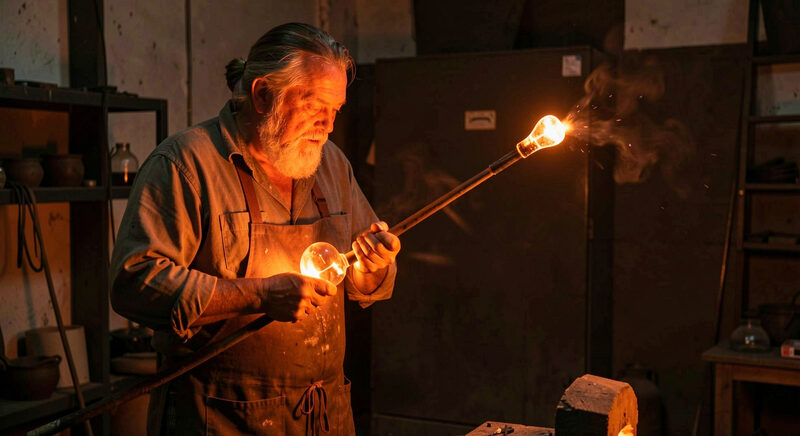
Murano Glass and the Mirror Makers
Why the glass furnaces moved to Murano, how cristallo was made, and how the island guild rules shaped the mirror trade for two hundred years.
Cristallo, the guild and the rules that kept the mirror on one island.