Styles and Forms
Murano Style Mirrors
How Murano style mirrors use coloured and crystal glass, gold leaf and applied flowers, and how they differ from a classic Venetian mirror.
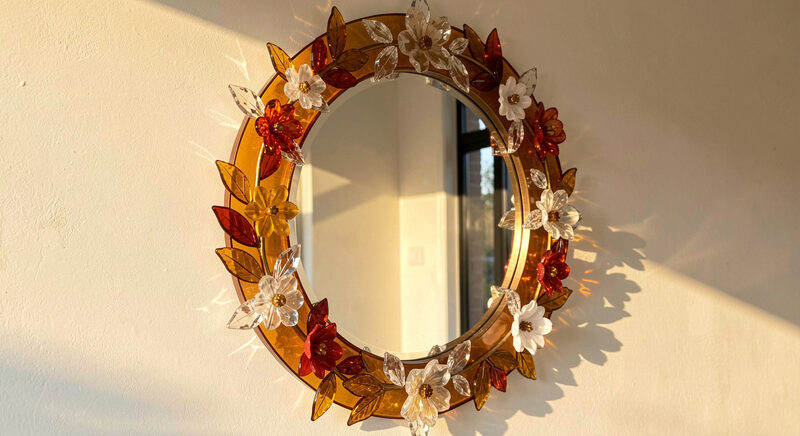
A Murano style mirror is a Venetian mirror that has been allowed to use colour. The construction is the same, a glass frame around a central pane, but where the classic type keeps to clear crystal, a Murano style frame brings in amber, aquamarine, blue, green, smoked and gold glass, and often adds applied flowers, leaves and ribbons in several colours at once. The result is warmer and more decorative, and it changes the way a room feels far more than a change of shape does.
Where the colour comes from
In most Murano style work the colour is in the glass itself, not painted on. Metallic oxides are added to the melt to produce the tone: cobalt for blue, copper or iron for green and aquamarine, manganese for violet, and various combinations for the amber and smoked greys that are especially common on mirror frames. Because the colour runs through the material, it does not rub off and it does not fade in the way a surface coating would. The depth of the tone depends on how thick the piece is, so a chunky bevelled element reads much darker than a thin strip cut from the same glass.
Gold leaf and the warm frames
Many Murano style frames use gold, and the gold is usually real gold leaf sealed inside or behind the glass rather than a gold coloured paint. The technique is old: a thin layer of gold is laid on the glass, sometimes with a coloured glass layer over it, and the whole is fused or bonded so that the metal is protected. The advantage is that the gold cannot tarnish or be worn away by cleaning, and it gives a warm glow that shifts as you move past the mirror. A gold glass frame against a dark wall is one of the most effective ways to bring warmth into a cool room.
Applied flowers, leaves and ribbons
The most recognisable feature of the Murano style is the applied decoration: glass flowers, leaves, rosettes and twisted ribbons, blown or pressed separately and then fixed to the frame. Some pieces are engraved as well, so that the surface carries both the sculpted ornament and the fine cut lines of the classic tradition. Applied work is the most fragile part of any mirror, because each flower stands proud of the frame and can be broken by a knock, which is why these pieces need careful handling when they are moved.
How it differs from a classic Venetian mirror
The difference is not one of quality but of intention. A classic Venetian mirror is built to throw light and to look cool and bright in a formal interior. A Murano style mirror is built to add colour and ornament, and it often suits a warmer, more casual or more contemporary setting. Both are made the same way at the bench, and both depend on hand cutting, bevelling and assembly. A buyer who prefers one is not choosing a better object, only a different effect. The classic type is described in the guide to the Venetian mirror, and the shared construction in the craft section.
Colour and the light in the room
Colour in a frame behaves differently from colour on a wall, because it is lit from two directions at once: the room lights the frame, and the frame reflects the room. An amber or gold frame in a north facing room can lift a cold, flat light, while a blue or aquamarine frame in a very sunny room stays calm rather than glaring. A smoked grey frame is the quietest of the coloured options and is often chosen where a clear frame would look too bright and a gold one too warm. It is worth holding a sample of the glass against the wall in the actual room before committing to a large piece, because the same frame can look very different under a different light.
The shapes it suits
Murano style colour works on every shape in the Venetian family. It is especially common on round and oval mirrors, where the frame follows a curve and the applied flowers can be arranged evenly around the border, and on crest mirrors, where a compact group of coloured ornament sits above the pane. It is also used on bubble frames, where coloured domes replace the clear ones, and on mirrored furniture, where a coloured edge can frame a mirrored top or panel.
Care and the finish
Coloured glass and applied flowers change the care routine in one important way: the ornament is fragile and the gold layer, though protected, should not be soaked. Cleaning is done on the flat glass with a soft cloth, and the applied pieces are dusted rather than wiped. The general routine is set out in the article on cleaning and caring for a mirror, and the choice between bright and aged reflective surfaces is covered in the article on finishes.
Buying a Murano style mirror
Because the term Murano style is descriptive rather than a guarantee of origin, it pays to look at the glass rather than the label. Hand worked coloured glass shows small variations, occasional bubbles and slight differences between pieces that are meant to match. Uniform colour and perfectly identical elements suggest a moulded or machine made frame. None of that is a defect, but it should be reflected in the price. The background of the craft, including the recipes and the families of makers, is gathered in the encyclopaedia entry on Murano glass, which is a helpful reference before you buy.