Care and Ownership
Cleaning and Caring for a Mirror
Cleaning a silvered or antique mirror without lifting the finish: what to use on the glass, what to keep away from the edges, and how to dry it.
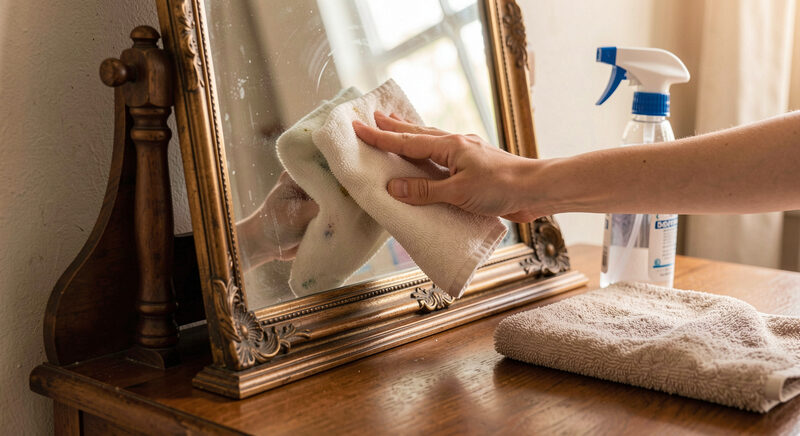
A Venetian mirror is not difficult to look after, but it is easy to damage by cleaning it the way you would clean an ordinary bathroom mirror. The reflective layer sits behind the glass, the frame is itself made of glass, and the ornament is fragile. Almost all the harm done to mirrors at home comes from liquid reaching the edges and from abrasion on the surface, and both are avoidable with a slower, drier routine.
The weekly routine
Most of the time a mirror needs nothing more than dust. Use a soft, dry cloth, or a brush with very soft bristles for the engraved and applied parts, and work gently from the top down so that dust does not settle on a part you have already cleaned. A light pass once a week keeps the surface bright and stops dust from combining with moisture to form a film that is harder to remove later. This is also the moment to glance at the edges of the glass, where any change in the backing will show first.
What to use on the glass
When the glass does need washing, use as little liquid as possible. A soft, lint free cloth, barely damp with water, is usually enough. If a mark persists, a very small amount of mild soap in the water will lift it. Distilled or filtered water is better than hard tap water, because the minerals in hard water leave a faint film that is visible on a large pane. Apply the cloth to the glass, never a spray to the mirror, and keep the cloth away from the edges of the frame so that no water runs behind the glass.
What to avoid
Avoid ammonia based cleaners, alcohol, vinegar and any abrasive paste or powder. These can attack the reflective backing if they reach the edge, and they can dull an engraved surface over time. Avoid paper towels, which are abrasive enough to leave fine scratches in soft glass. Avoid spraying anything directly onto the mirror, and avoid soaking the frame, the applied flowers or the bubble domes. Finally, avoid the habit of wiping a mirror with the same cloth used for furniture polish, because the oils in the polish will smear the glass and settle into the engraving.
Drying matters more than washing
The most important step is drying. After any damp cloth has touched the glass, go over the surface again with a dry, soft cloth until it is completely dry, and pay particular attention to the lower edge of the frame, where water collects. A mirror that is left to air dry will show streaks, and a mirror whose edges stay damp will begin to fox at the bottom first, which is exactly what the conservation literature describes on historic mirrors. Drying is quick and it is the single habit that most extends the life of the backing.
Engraving, applied flowers and bubbles
The ornament is cleaned with a brush rather than a cloth. Fine engraving holds dust in its grooves, and a soft brush lifts it out without pressing on the glass. Applied flowers and leaves should never be wiped firmly, because a knock can snap a petal or loosen the fixing. Bubble frames are dusted with the same soft brush, worked between the domes, and the flat pane is then dried with a cloth. For all of these, a dry brush is safer than a damp cloth.
Antique and aged finishes
A mirror with a deliberately aged or genuinely old reflective surface needs more caution than a bright one, because the backing is less firmly bonded and any liquid at the edge can lift it further. Clean only the flat glass, work quickly, dry immediately, and do not attempt to polish away dark patches. Patina is not dirt. Trying to brighten an antique surface, whether by polishing or by having the mirror re silvered, will remove the very quality that made the piece interesting, and re silvering an antique mirror is almost always a mistake.
Humidity and siting
Prevention is easier than cure. Keep a mirror off cold external walls and away from direct steam, from the splash zone beside a bath or shower, and from the heat of a radiator. A dry interior wall with side light is ideal. In a very damp house, or in a coastal location, it is worth checking the back of the mirror occasionally for any sign of moisture and, if necessary, moving the piece to a drier room. The conditions that age a mirror are described in the article on finishes.
When to call a conservator
If the backing has begun to lift in visible patches, if the frame has cracked, or if an applied piece has broken, the repair is a conservation job rather than a household task. Look for a conservator with experience of glass and of historic mirrors, and expect the work to be stabilisation rather than restoration: the aim is to stop further loss and to make the damage less distracting, not to return the mirror to new. Reversible treatments are preferred, and any work should be documented, with photographs before and after. The same principle is applied to museum mirrors, as the Smithsonian design museum's account of conserving silver leaf mirrors shows: Conserving Silver-Leaf Mirrors.
Records and records of condition
Keep a note of when the mirror was cleaned, what was used, and any change you notice in the surface, with a dated photograph. Over years this becomes a useful history, and it helps a conservator understand what has been done before. It also protects the value of the piece, since a documented mirror is easier to sell and easier to insure. The practical side of moving and storing is covered in the section on living with a mirror and in the article on packing and shipping.